Building the AlAblam Legal Platform — A Full-Stack Engineering Deep Dive
How I engineered a complete full-stack legal services platform for a premier Dubai law firm — from requirements to production deployment.
Overview
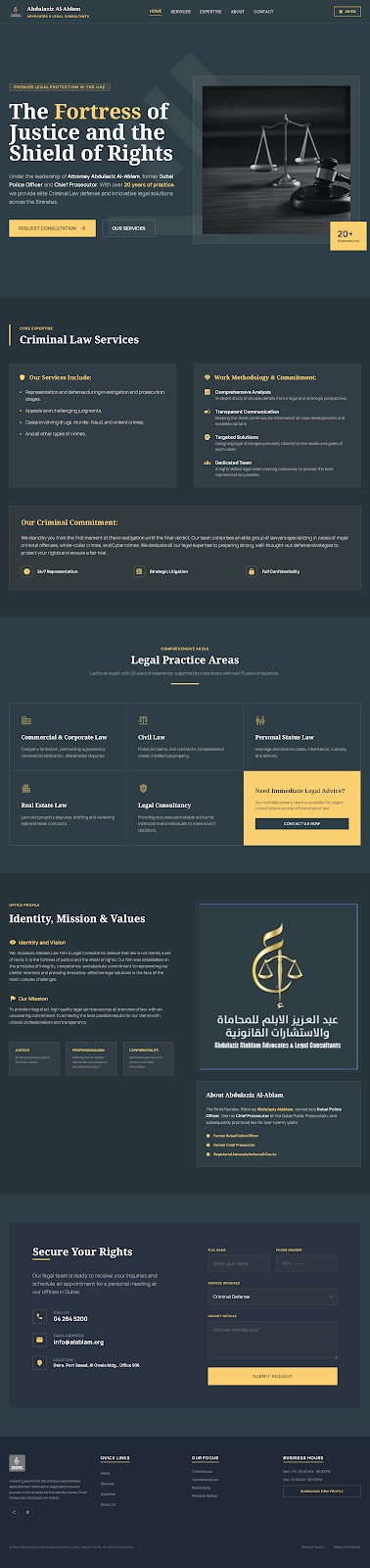
When Abdulaziz Alablam Advocates & Legal Consultants approached me, they needed more than a website — they needed a complete digital transformation. The existing setup was a static brochure site with zero operational capability. The goal was to build a premium, multi-lingual, full-stack platform that would handle real client inquiries, showcase the firm's expertise, and provide an admin-controlled content management system.
This article walks through the technical decisions, architecture, and challenges I encountered building alablam.org.
The Requirements
Before writing a single line of code, I spent time understanding the business:
- Public-facing site: Bilingual (Arabic & English), RTL-aware, premium legal branding.
- Inquiry system: Clients submit case inquiries → routed to the right legal team.
- Admin dashboard: Non-technical staff can manage content, view inquiries, and update team profiles.
- Security: A legal firm handles sensitive client data — security was non-negotiable.
- Performance: Sub-2-second load times, Lighthouse score ≥ 90.
Tech Stack Decision
// Frontend
const frontend = {
  framework: "React + Vite",
  language: "TypeScript",
  styling: "Tailwind CSS v4",
  animation: "Framer Motion",
};

// Backend
const backend = {
  runtime: "Node.js",
  framework: "Express.js",
  auth: "JWT + bcrypt",
  database: "MySQL (Supabase)",
  monitoring: "Sentry",
};
I chose Vite over Next.js for the frontend here because the site didn't require SSR — all dynamic data was fetched via API. This kept the build blazing fast.
Architecture
The system follows a clean separation:
client/          → React SPA (Vite)
server/          → Express REST API
  ├── routes/    → /auth, /inquiries, /content, /admin
  ├── middleware/ → authMiddleware, rateLimiter, helmet
  └── db/        → MySQL connection pool, migrations
API Security Layers
Security was implemented at multiple levels:
- Rate Limiting —
express-rate-limiton all public endpoints (10 req/min on inquiry submission). - Helmet — HTTP security headers out of the box.
- Input Validation —
zodschema validation on every request body. - JWT Rotation — Short-lived access tokens (15 min) + refresh token rotation.
- Sentry — Error monitoring with PII scrubbing enabled.
The Inquiry System
The most complex part was building the case inquiry flow:
// server/routes/inquiries.ts
router.post("/submit", rateLimiter, validateBody(inquirySchema), async (req, res) => {
  const { name, email, phone, caseType, description } = req.body;

  // 1. Store in DB
  const inquiry = await db.inquiry.create({ data: req.body });

  // 2. Send notification email to legal team
  await sendEmail({
    to: process.env.LEGAL_TEAM_EMAIL,
    subject: `New ${caseType} Inquiry — ${inquiry.id}`,
    template: "new-inquiry",
    data: { name, caseType, inquiry },
  });

  // 3. Send confirmation to client
  await sendEmail({
    to: email,
    subject: "We received your inquiry",
    template: "inquiry-confirmation",
    data: { name },
  });

  res.json({ success: true, inquiryId: inquiry.id });
});
This pattern — store → notify team → confirm to client — handled everything reliably.
Results
After 4 months of development and 2 weeks of testing:
| Metric | Result |
|---|---|
| Lighthouse Performance | 92 / 100 |
| Load Time (3G) | < 2.1 seconds |
| Monthly Inquiries Managed | 100+ |
| Uptime | 99.9% |
| Security Headers | A+ (securityheaders.com) |
Lessons Learned
1. Start with the data model. Every bug I encountered in the admin dashboard came from an underspecified schema. Get that right first.
2. Email reliability is hard. I went through three email providers before settling on one that delivered consistently without hitting spam filters.
3. Bilingual UX is more than RTL. Arabic users don't just need text mirrored — they expect different visual hierarchy, font weights, and content density. Involve a native speaker in design reviews.
4. Rate limit aggressively. A legal firm's contact form is a prime target for scraping and spam. Ship rate limiting from day one.
Final Thoughts
This project reinforced something I believe deeply: the best engineering work is invisible to the end user. The client didn't care about JWT rotation or schema validation — they cared that the platform worked, felt premium, and helped them serve their clients better.
That's the real goal.
Share this article
Youssef Mahmoud
Full-Stack Engineer & Project Engineer
Have a project in mind?
Let's discuss your requirements and build something great together.
Book a Strategy Call